
I grew up believing in the Jewish religion. I went to Hebrew school for 12 years, became a bar mitzvah, went on a Birthright trip, and worked on a kibbutz. My entire genealogy that’s traceable is Jewish; I have zero documented Gentile ancestors.
I used to believe that the Jewish theology was the correct one: that God created a special favorite tribe through a man named Abraham, and spoke to a man named Moses and told him to write what’s in the Torah, and that the Torah was an accurate depiction of who God is, and what God did, and what God wants.
I no longer believe that. I do not subscribe to the religion of Judaism anymore.

Hopefully my story will inspire some Jewish people to introspect and reflect on the topic of “why Gentiles don’t like Jews”, and learn that there are actual reasons – and then, equipped with this knowledge, make some changes so that we stop giving Gentiles these reasons. The goal here is peace and coexistence, which includes safety and security for people who are Jewish.
My Jerusalem Visit
On my second visit to Israel, when I worked on the kibbutz, I took a weekend trip to Jerusalem, by myself, to have a look around at what I thought was supposed to be my ethnic capital city.

I stayed at a hostel in the Jewish Quarter, and while there I noticed a flyer on the wall, advertising a program where guests could go have dinner with an ultra-orthodox family somewhere in the city, to learn about their culture and study some Torah.
Who could turn down free dinner? (I feel like there’s a Seinfeld joke in here somewhere)
Their house was small, undecorated, and rather spare; and all of their money seemed to have been spent on the massive bookshelf of religious texts that covered the entire wall and dominated the main room. They had several small children running around. Most surfaces were sticky. I imagined that they didn’t have time to clean much, with all the religious study all day long.
The food was alright. They were talkative and friendly. My impression of them was “strange… but nice.”
But then, everything changed when the dad brought out the Torah.
For those who don’t know, a “parsha” is a fraction of the Torah that corresponds to the current week of the year). And that week’s parsha included something that I had never been taught, in my liberal-leaning Reform synagogue.
This is going to sound like it’s from a movie script. But it is not.
That week’s parsha included…
Really guys, I ain’t shittin’ you here. This really, literally happened.
That weeks’ parsha included…
…Amalek.
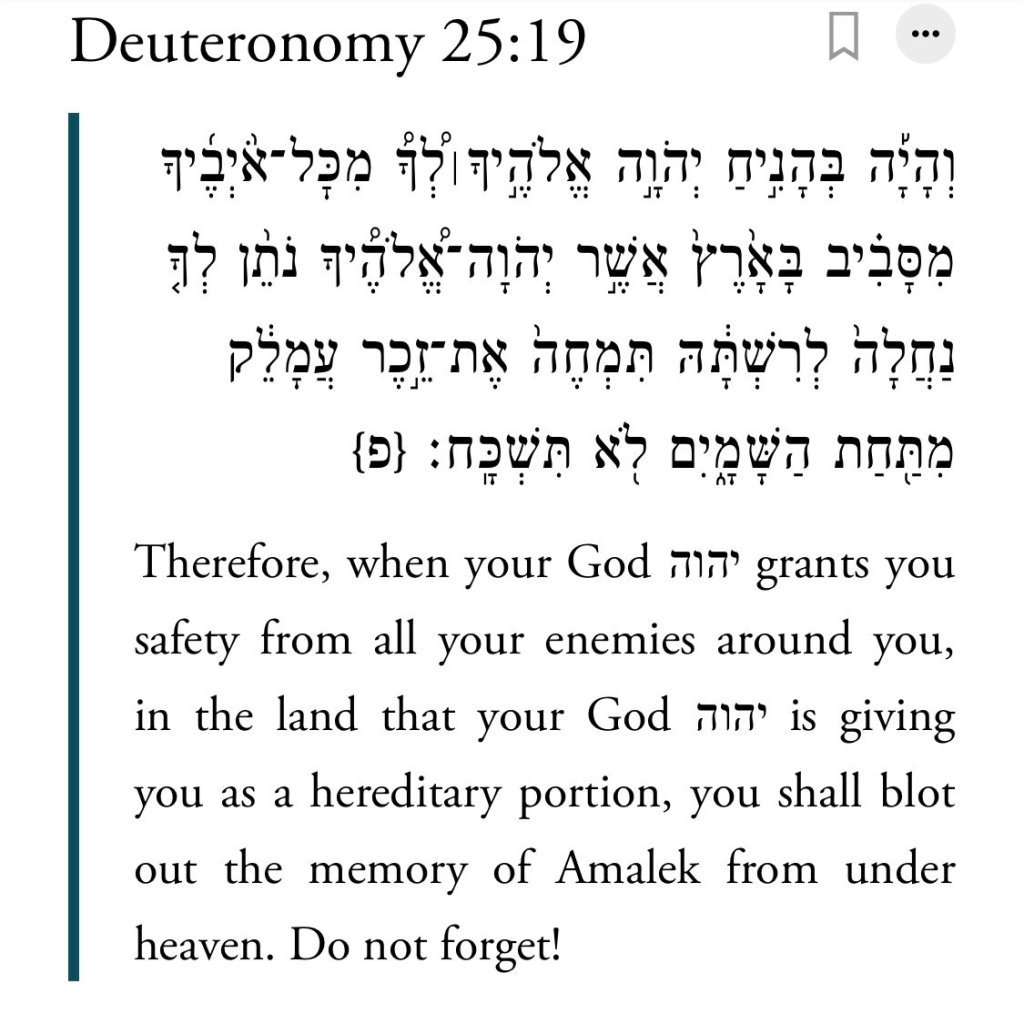
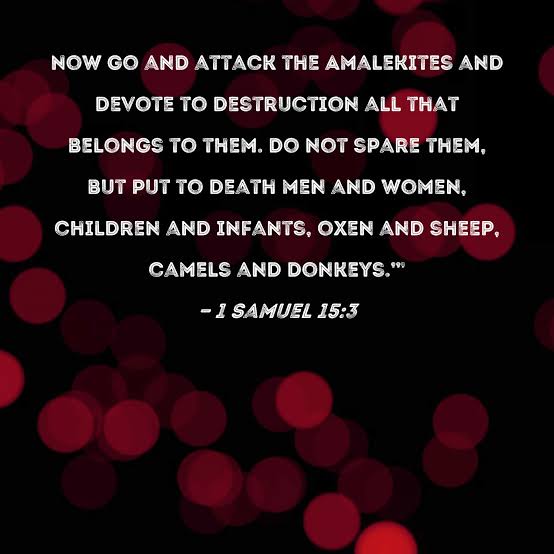
He specified that “blot out the memory” means to exterminate every man, woman, and child in the entire nation, down to the last little baby, as was commanded by Samuel:
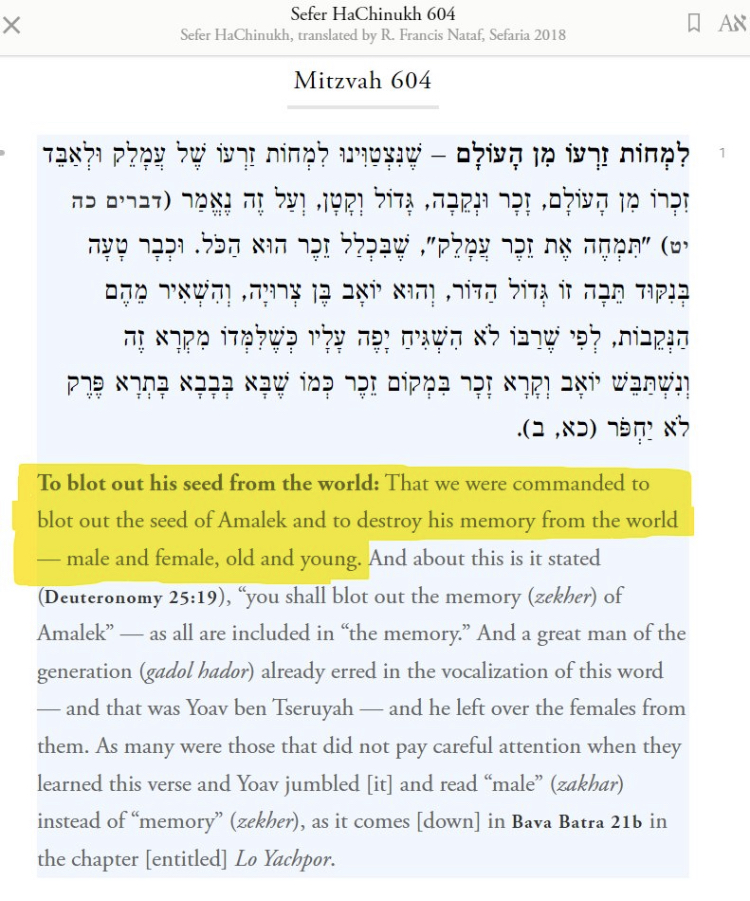
And reaffirmed in the Talmud:
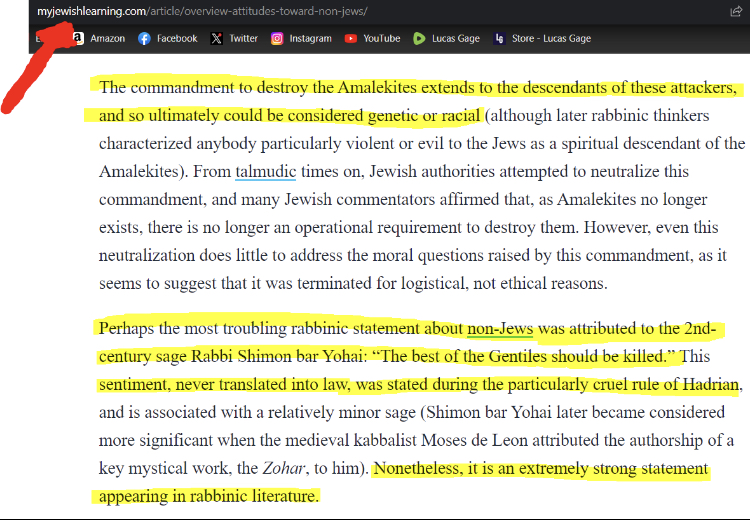
And this commandment applies to the present day, as you can see here on MyJewishLearning.com
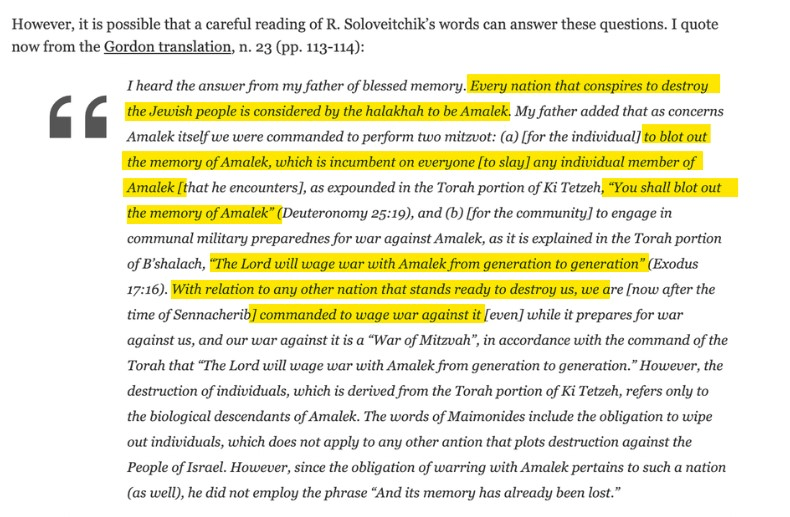
I had never heard of Amalek. No one ever mentioned it while I was growing up. Or if they did, I must have not been paying attention. Or maybe I heard it at some point but failed to appreciate the gravity of what it implies. I’m going with the latter theory, actually. Most of us can hear this stuff said over and over again and still not have it “click.”
The Amalek commandment only takes up one paragraph, and the parsha is many pages long. He selected that one paragraph, specifically, out of a large body of text. It must have been very important to him. The most important part of the entire parsha, obviously.
But me? I was dumbfounded. I couldn’t believe that was in the Torah. I had been taught that this book was “a tree of life for all who cling to it”. This book was the foundation of my tribal mythology. The freakin’ Torah! It said THIS in it?
I assured myself that he didn’t really believe in following this. Jewish people didn’t really believe in following this. It was only a… ceremonial formality! Like, um, you’re supposed to verbally recite the commandment to mass-exterminate every Amalekite, but not actually do it. It’s not to be taken literally. It’s a metaphor. For… something. Right?
…Right?
So I asked him, “This is only a metaphor, right? I mean you’re not actually intending to exterminate a whole race of people. It’s symbolic… right?”
To my horror, he responded, “No, it’s not a metaphor, it’s literal.”
The conversation then went something like this:
Me: “Ok so like… if an Amalekite was sitting here… like let’s say a child… an Amalekite child… same age as tiny Yehuda over there… you would… uh… kill the child?”
Him: “Of course. It says to do it, right here in the Torah. It’s a commandment.”
Me: “But… that’s… evil.”
Him: “It’s not evil. God wouldn’t command us to do something evil. If God commands it, it’s not evil. It’s good by definition, because God commanded it.”
Me: “But why would God command you to… uh… kill children?”
Him: “Because the child carries the seed of Amalek. Amalek is in their blood. And the only way to eliminate that seed is to exterminate everyone who has it. If you let the child live, he will grow up to be an adult, an adult with the seed of Amalek, and he will attack Jews, and he will reproduce and multiply and create even more Amalekites, and keep the line going, so they can keep attacking Jews. You might think you’re being merciful to the child, but you’re not being merciful to all of the Jews the child and his progeny will make war upon, for ages and ages further. It’s better to eliminate him and his seed, forever. That’s why it says so in the Torah. God is wise!”
Me: “So you’re saying the point is to… uh… exterminate a race?”
Him: “Correct. The race of Amalek.”
Me: “But I thought the world agreed that… like… you’re like… not supposed to… like… exterminate races.”
Him: “Well the world is one thing, and the Torah is another. In the Torah, God commands us to do it. God’s ways are not always the world’s ways. We follow God.”
Me: “Ok… but like… how is that different from… say… Hitler?”
Him: “How is it similar?”
Me: “Uh… because… Hitler… wanted to do that…”
Him: “Do what?”
Me: “Extermination…”
Him: “Extermination of whom?”
Me: “Uhh… the Jews…”
Him: “Right, the Jews. The Torah doesn’t say to exterminate Jews. It says to exterminate Amalekites.”
Me: “So how are you different from Hitler and the Nazis?”
Him: “There’s no difference except that God commanded one, and not the other. It’s not written in the Torah to exterminate the Jews. It’s written in the Torah to exterminate the Amalekites, because their seed is evil, and anyone born to that nation will have an evil seed. God didn’t tell Hitler to kill the Jews, but he DID tell us to kill the Amalekites. If God had told Hitler to kill the Jews, then Hitler’s actions would have been righteous. But God didn’t tell Hitler to do that. He told us to do that. That’s the difference.”
Whoa.
The thing that was most alarming to me was how un-alarmed he was. He didn’t act like someone whose beliefs were under attack. He wasn’t offended at all. His demeanor was nonchalant. He wasn’t upset that I was criticizing his religion and comparing it to Nazism, right there in front of his family and his other guests. He was completely undisturbed, and secure in his conviction that murdering children is the right thing to do – so secure in it, that he didn’t feel threatened by my questioning at all, and didn’t even get angry or frustrated with someone openly disputing his core beliefs.
It was eerie and uncanny. If he had been a skinhead with a swastika tattooed on his face, it would have felt more wholesome, because at least such a person is congruent. All of their words and beliefs and behavior align. They hate, and they hate what they hate, and that’s that. But this guy’s demeanor wasn’t matching his words. There was no anger or hatred in them. He was speaking of mass-murdering an entire race without a shred of aggression or malice – not in his voice, not on his face, and not in his body language. There was no animosity in it. It was perfunctory. As if murder was a perfectly mundane item produced and canned on an assembly line.
I decided to press further.
Me: “Who do you think the Amalekites are, today?”
Him: “Well there are several theories. Some say the Arabs. Some say the Germans. But I have my own theory!”
Me: “Oh yea? What is it?”
Him: “I think they might be the Armenians.”
Me: “What?? Why them?”
Him: “Because as you know, the City is divided into 4 quarters, and 3 of them correspond to a religion. There’s a Jewish quarter, a Christian quarter, and a Muslim quarter. And then, for some strange reason, the Armenians have their own quarter. Isn’t that weird?”
Me: “Yea, it’s a bit weird. But how does it mean that the Armenians are Amalek?”
Him: “Well it’s just a guess really. Most people I know think the Arabs are Amalek.”
Me: “So does that mean you have a divine commandment to kill all of them, down to the last woman child and baby?”
Him: “Yup! Whoever Amalek is, we have to do that. But you’ll be happy to know that there’s no agreement within the Jewish community as to who Amalek is, and until we agree on who they are, we can’t carry out the commandment. And we’ll probably never agree. You know, if there are 2 Jews in a room, the room has 3 opinions in it.”
Me: “But… if you ever did agree on who they are… then you’d carry out the commandment?”
Him: “Of course.”
Me: “And you don’t see that as wrong at all?”
Him: “I can see how the world sees it as wrong, certainly. But the world doesn’t follow the Torah. And the Torah is what matters.”
And at this point, I got up and left. I was horrified, and exasperated, and shocked. And after trying to reason with him, and failing, I had no further way to register my disgust, so I walked out.
The next day, I did an experiment. I walked around the Old City, all day long, looking for Orthodox Jews who could renounce the commandment to exterminate a race. I just approached them randomly, making conversation, and then asking them about the Amalek passage. I asked them on sidewalks, in cafes, and even at the Kotel.

I felt like I was Abraham in Sodom, searching for 10 reasonable Jews, in order to prove that we’re not an evil People.
And I found none.
My best result was a pair of dudes at the Wall who rubbed their yarmulkes a bit and said it was an interesting dilemma, and they’d have to “think about it.”
But not a single person was willing to just say “No, I will not exterminate a race.”
And that’s the day I decided to stop being not only a Zionist, but a Jew in both the religious and cultural sense. I knew, that day, that something was fundamentally wrong with the religion, and so I decided to stop identifying with it.
I can’t change my ancestry, and I can’t change how I was raised, and I can’t change my predilection for bagels and schmear and lox. I can’t erase my memories of Hebrew school, and Jewish prayers, and Jewish holidays, and my bar mitzvah, and of singing Ha’Tikva while saluting the Israeli flag at summer camp. But I no longer identify as a member of a tribe whose core mythology revolves around being the Chosen People.
I don’t believe in it anymore. How can I? The Torah is the foundation of it all, and the Torah says to Final Solution a race. That clearly proves that the book was not written, nor inspired, by God. It’s merely a political tract. And judaism is not a religion – it’s a political ideology.
The idea of Jews being a superior race destined to conquer and subjugate the world and forcefully destroy all cultures, starting with Palestine and eventually consuming the entire planet, is written into the religious texts of Judaism from the 5 Books of Moses onwards. It’s repeated over and over again, from cover to cover.
To identify with Judaism is to believe in the Torah and its supporting texts; and to believe in those texts is to accept the idea of violent Jewish supremacy culminating in a permanent global totalitarian Jewish theocracy and the merciless erasure of all human culture.
Back when I discovered all this, I didn’t expect it to ever “matter” in a material sense. I never thought that the Amalek passage, and all of the many other “kill em all” passages, would ever be brought out to justify actual action, in the real world. I expected it to remain a purely academic discussion.
But then, less than two years ago, the world saw that it’s not academic at all. It’s material. Because Jews are carrying out the instructions, right now, in Gaza.
Netanyahu even cited the Amalek passage to justify it.
Clearly not an academic discussion. It’s real. It matters.
But I still remember the two dudes who rubbed their yarmulkes in thought. They prove that there’s hope. If even a little light can get through the cracks, then all is not lost. So while I’ve given up the ideology of Judaism, I have not given up on the People.
All human beings are endowed with free will. All are capable of change. Every Jewish person is capable of recognizing the toxicity in his or her belief system, and prioritizing the values of Reason and Empathy, and thereby evolving. And if enough Jews evolve, we have a real chance at living in peace, and getting along with the rest of humanity, free from antisemitism, in a mature civilization.


 The *Good* Jews!
Leave a reply to jackie Cancel reply